
Last for the chapter!
- Diffraction Grating
- Equation: nλ = d sin θ
- White light through a diffraction grating
Let’s go!
What is a diffraction grating?
A plate with a large number of closely spaced parallel slits.

What happens when monochromatic light is sent through a diffraction grating?
A pattern of narrow bright fringes is formed.

This pattern is caused, once again, by interference of light waves.
What equation is used to describe the fringe pattern?

If you have sharp eyes, you’ll notice that this is similar to the equation used to describe single-slit interference.
HOWEVER, the purpose of this equation is DIFFERENT:
This describes the pattern of BRIGHT MAXIMA, not the minima in the equation for single-slit interference.
How do you use this equation?

d = spacing between adjacent slits
θ = angle from centre line to maxima
n = order of maximum (0,1,2,3,…)
λ = wavelength of light
The 0th order maximum is the bright maximum at the centre, the 1st order maxima are the 2 maxima closest to the centre, etc.

From HyperPhysics
Let’s try a classic example.
Given:
- number of lines per metre = 5.00 x 10⁵
- 3rd-order maximum observed at an angle of diffraction of 78°
Find λ.
| STEP 1: Calculating d | If there are x lines per metre, the distance between the lines is 1/x*. *Of course, it should be 1/(x-1) if you think logically, but since x is a very large number, it doesn’t make much of a difference. In this case, d = 1/(5.00 x 105) |
| STEP 2: Substituting the values into the equation |  |
| STEP 3: Finding |  |
What happens when you send white light through a diffraction grating?
The different frequencies (colours) making up white light will be diffracted by a different amount, since they have different wavelengths.
Since violet & blue have the shortest wavelengths, they will have smaller angles.
Since red has the longest wavelengths, it has the largest angle.
It should look like this:
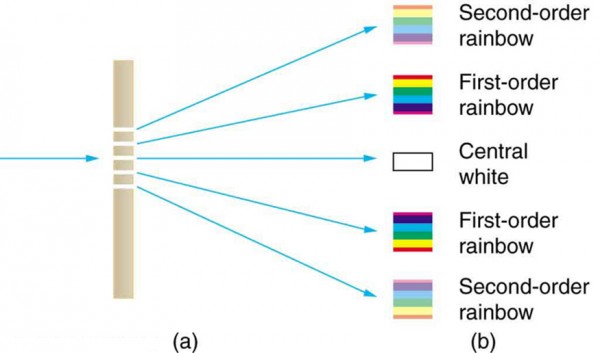
A real-life image would look like this:

What’s an application of diffraction grating?
It can be used as a SPECTROMETER.
This is a tool used to identify the wavelength(s) of light that is sent through it.
⇐ Previous in Physics: Single Slit Interference
⇒ Next in Physics:
 ProDuckThieves
Pingback: PHY C15: Single-Slit Interference – ProDuckThieves